How to Create a Good Europass CV
A guide to the Europass CV that includes what it is, the sections in it, how to build it, when to use it, and some criticisms against it.
Before diving into how to create a good Europass CV, it is pertinent to understand Europass as a concept. Europass is an initiative of the European Union (EU) meant to increase the transparency of qualifications and mobility of citizens in Europe, hence making it easier to study/train and work in different European countries.
It comprises a set of online tools (including a Europass profile and a CV editor) and information that helps you manage every step of your learning and career. The tools and information support you in communicating your skills, qualifications and experiences clearly and consistently across Europe. The 20th anniversary of Europass was celebrated earlier this year.
What Is Europass CV?
Europass CV is a standardised CV format and a component of the Europass initiative that supports learning and employment opportunities within Europe.
It is one of the best-known CV formats in Europe and provides a clear and consistent way for individuals to present CV information so they can be easily understood by employers and institutions.
Between February 2005 and November 2019, 150 million Europass CVs were created online. Sometime ago, it was reported that 8.5 million Europass CVs had been downloaded in 2025.
Sections in a Europass CV
Compulsory Sections
- Personal Information
- Work Experience
- Education & Training
- Personal Skills
Additional Information
- Certifications
- Conferences and Seminars
- Creative Works
- Driving License
- Hobbies and Interests
- Honours and Awards
- Networks and Members
- Projects
- Publications
- Recommendations
- Social and Political Activities
- Voluntering
- Other
- Closing Statement

How to Create a Good Europass CV
To create a good Europass CV, you will first have to create your Europass profile with information on your education, training, work experience and skills.
After you complete your Europass profile, you can create as many CVs as you want with just a few clicks. Just select which information you want to include, pick your favourite design, and the Europass CV editor will do the rest.
The Europass CV can be created in 31 languages.
Note: You can create a Europass CV without having a Europass profile. All you need to do in this instance is to enter your details directly into the Europass CV editor.
However, if you create a Europass profile, your information (including education, work experience, skills, and qualifications) is saved and can be reused, updated, and adapted easily for future applications.
You can download and store your Europass CV in your Europass Library (if you are a registered user) or on your local device.
When Should You Use a Europass CV?
Here are the situations where a Europass CV format is most appropriate:
1. When Applying for Jobs in Europe
A Europass CV is ideal if you are applying for roles in EU or EEA countries. Many European employers are familiar with the format and find it easier to review because it follows a standardised structure. This is especially useful when:
- The job posting mentions Europass CV as a requirement
- The employer receives applications from multiple European countries
- The role is in the public sector or a regulated profession
2. When Applying for EU-Funded Programs
You should use a Europass CV when applying for:
- Erasmus+ programmes
- European Solidarity Corps
- EU-funded internships, fellowships, or research programmes
Most of these programmes explicitly request a Europass CV format because it allows evaluators to compare candidates fairly.
3. When Applying for Study Opportunities in Europe
Universities and training institutions in Europe often accept or request Europass CVs for:
- Master’s and PhD applications
- Exchange or mobility programmes
- Short professional courses and certifications
The format clearly presents your education, qualifications, and language skills, which are critical for academic applications.
4. When Your Qualifications Are European-Based
If you earned your degree, professional certification, training or work experience from a European institution, a Europass CV helps present those credentials in a format recruiters already understand.
In other words, your qualifications are less likely to be misunderstood, and employers can quickly see how your background aligns with European education and professional standards.
5. When You Need a Clear, Structured CV Quickly
Europass is useful if you need a CV quickly, without worrying about design. The built-in sections guide you to include all essential details, reducing the risk of leaving out important information.
6. Multilingual Applications
As noted above, Europass supports 31 languages. Additionally, your language skills are shown using a standard European proficiency scale (CEFR), making your level clear and comparable across countries.
In a nutshell, a Europass CV helps ensure your application is clear, consistent, and easy to understand when applying across borders or in multilingual contexts.
Tips for Creating a Good Europass CV
Present your experience clearly: Highlight examples of your skills and experiences that match the job you are applying for. Pay close attention to the details published in the vacancy notice.
Tailor your CV: Make sure you update the ‘About Me’ section to highlight why you are the best person for the job. Do not include a full detailed history. Focus on facts and main points that match the job you have in mind.
Make it readable: Make sure your CV is easy to read. Use clear and simple language. Use strong action verbs (e.g. ‘managed’, ‘developed’, ‘increased’).
Use reverse chronological order: Always list the most recent experience at the top, followed by previous ones. In case of long gaps in working or learning, include an explanation.
Polish and fine-tune: Check for spelling and grammar mistakes, provide a professional e-mail address, and add a professional photograph of yourself.
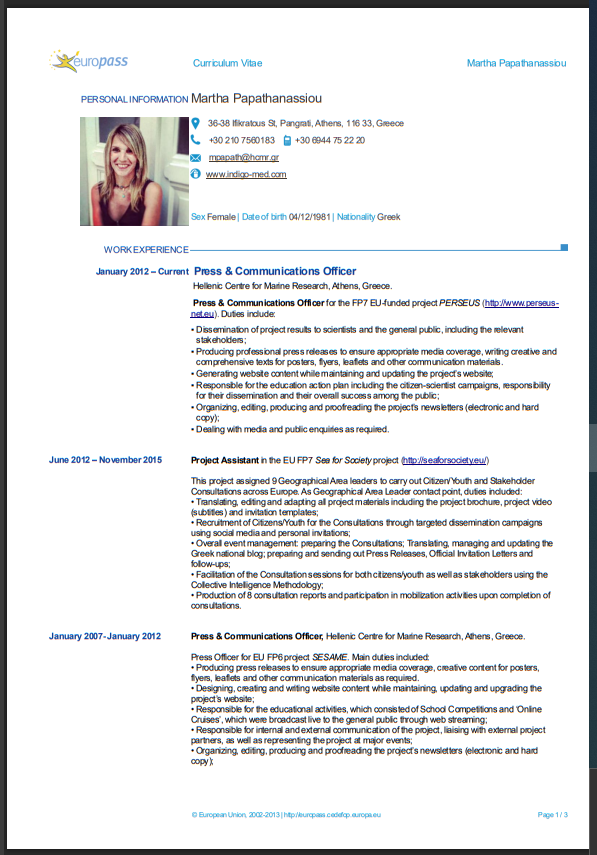
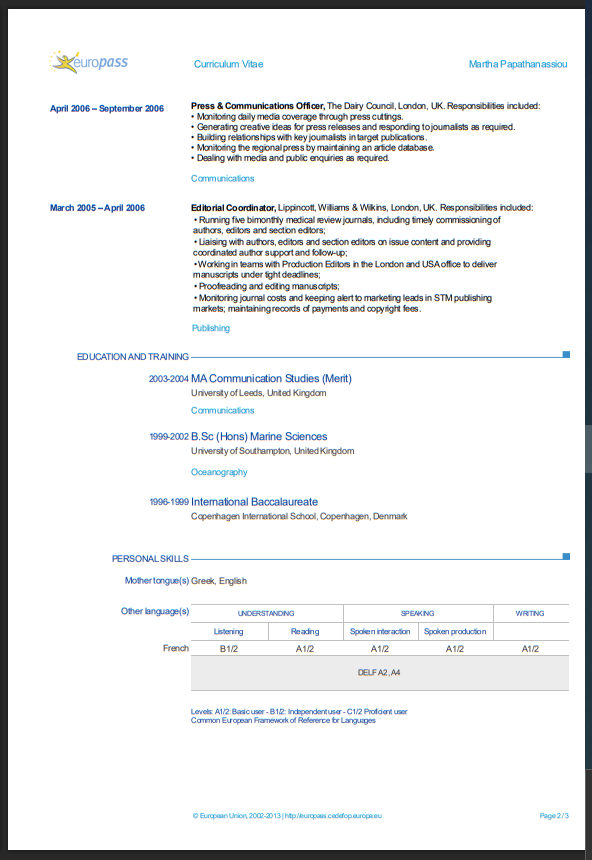
Europass CV Format Example
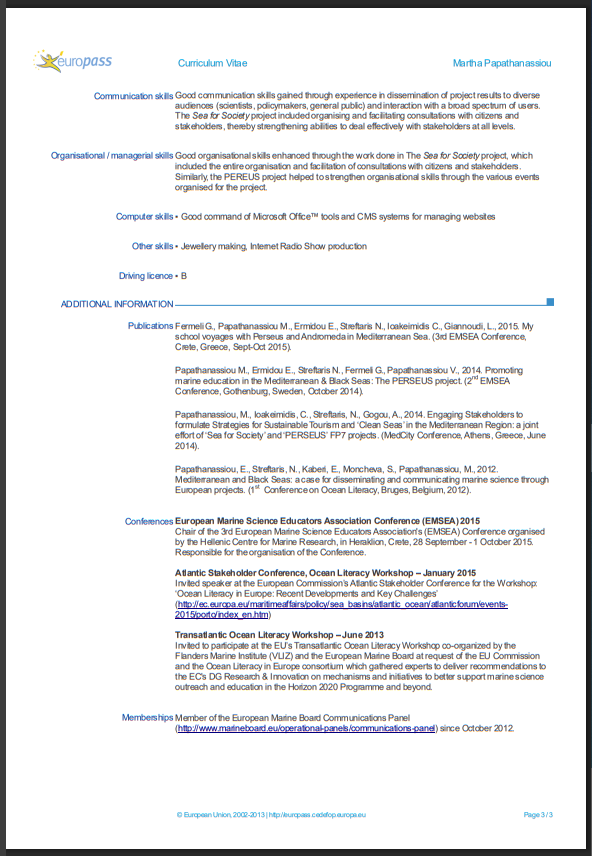
Criticisms of the Europass CV Format
Too rigid and standardised – The fixed format and sections make it hard to customise your CV or highlight your unique strengths creatively.
Looks generic – Many candidates use the same template, so it can be difficult to stand out among other applicants.
Limited design options – Only a few layout and style choices are available, which can be a disadvantage in fields where visual presentation matters.
Not fully ATS-compatible – Some Europass CV formatting may not be read correctly by Applicant Tracking Systems, meaning key information could be missed.
Less suited for non-European markets – Its structure and terminology follow European standards and may not match expectations elsewhere.
Conclusion
Learning how to create a good Europass CV starts with setting up a Europass profile and entering the needed information to include in your CV in the Europass CV editor. Alternatively, you can bypass profile creation and input your details directly into the editor.
However, while the Europass CV format is widely recognised across Europe, it is not devoid of criticism. For example, it can sometimes feel rigid and overly standardised, making it harder to uniquely highlight your individuality.
For a more flexible and impactful approach, the ATS-friendly CVHack offers tools to build, customise, and optimise your CV to specific roles, helping you stand out in today’s competitive job market while still meeting European standards.